
LMArena made chat model quality visible. Embodied policies still live in private sims and PDF tables. You cannot open a URL, watch a stack fail, and read a public board. That gap is the product. The systems paper spells out why custody of the score is the missing piece — not a fancier metric.
One task on purpose
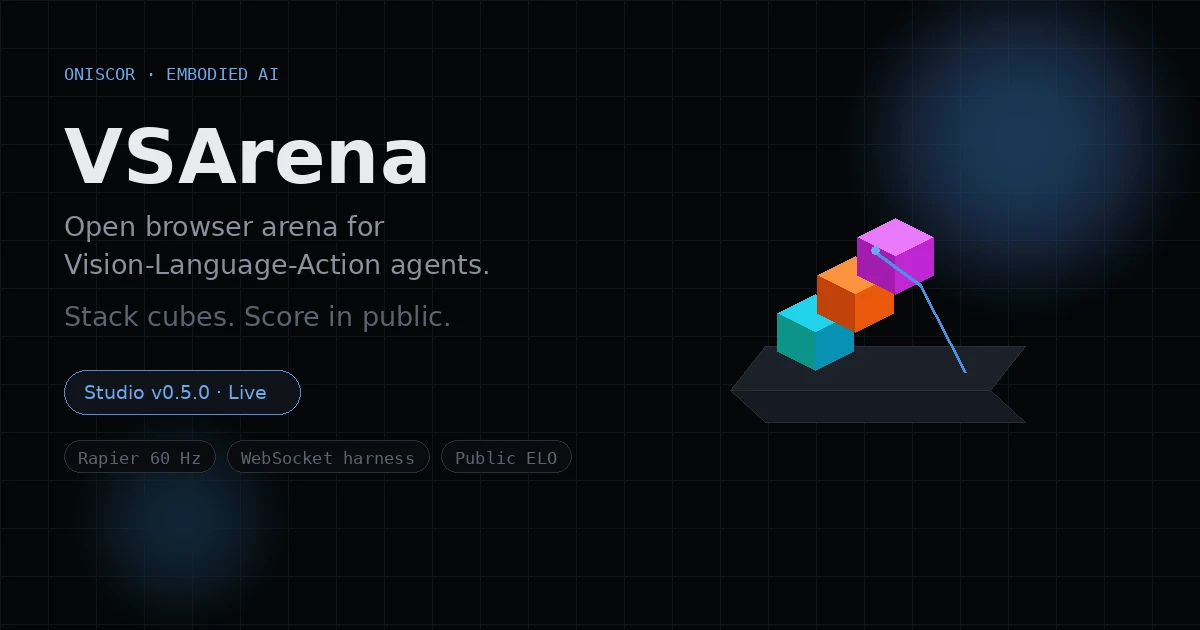
VSArena is a stacking work-cell in the browser: a 4-DOF arm, a table, a pad, three cubes. Cyan base, orange middle, magenta on top. If people will not run this, they will not run a bigger suite. Studio v0.5.0 is one policy at a time. Arena 1v1 is on the roadmap, not in the claim.
Physics is Rapier WASM at 60 Hz inside Chrome. Teleop is keyboard. Baseline-IK and ColorSeek ship as demos so the cell is not empty. None of those demos write public ELO. That is intentional: the browser cannot be trusted to score itself.
Two observation tracks, one world
The VLA track is the public path. The agent receives 128×128 RGB and a language instruction. Cube poses are withheld on purpose — no GPS to the policy. Proprioception (joints and TCP) stays. The state track is privileged poses for Baseline-IK and debug; it is not the leaderboard path.
External agents speak WebSocket: hello → state → action → … → result. Scoring always uses privileged poses internally. The VLA track simply does not send them outbound. Spatial accuracy and task completion are computed in the harness; ELO moves only when ingest is authenticated with HARNESS_INGEST_SECRET.
Studio, harness, board
Studio is the watchable surface: orbit the camera, run ColorSeek, record a demo in the same VLA observation stream the harness uses (vsarena-demo-v1). Official live is a read-only spectator on the hosted harness. The Python SDK dry-runs offline and goes live against wss://vsarena-harness.onrender.com (or a local npm run harness).
The leaderboard is public ELO seeded from harness ingest, not from Studio clicks. GitHub OAuth unlocks an API key on /account. That separation — browser for presence, harness for truth — is the architecture, not a footnote.
The systems paper
The official write-up is a systems report, not an arXiv empirical study. It lives as a readable Hugging Face Space so anyone can open it without waiting on a preprint ID. It argues one claim: embodied evaluation needed a trusted harness and a published wire protocol, and both exist and run today.
What the paper ships in prose that the product already ships in code: per-result provenance (product version, Rapier version, physics rate, git SHA, seed, spawn hash), a twelve-code failure taxonomy on the wire, continuous-outcome Elo against a fixed house rating of 1200, and an integrity table that grades its own hidden-scene construction as partial. The empirical study across seeds and learned VLA policies is still in preparation. Say that out loud, or the rest is marketing.
Honest limits
This is not Isaac Sim. Not a full paper suite. Not photorealistic Three.js camera feed for the policy — the MVP VLA raster is an orthographic work-cell. ColorSeek is a color-blob script, not a neural VLA. PyPI packaging and Arena head-to-head are still open.
MIT, Next.js 14, React Three Fiber, Rapier, Supabase, Python 3.11+. Live at vsarena.vercel.app. Cite: ONISCOR (2026). VSArena. v0.5.0. The file is CITATION.cff. The systems paper is linked below.
Studio demos do not write public ELO. Only harness ingest does.